
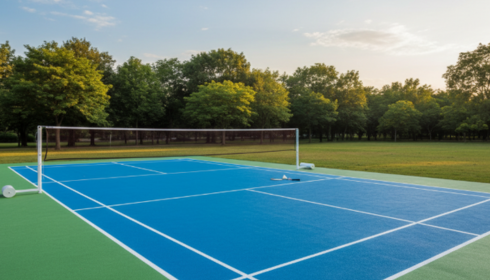
Badminton has grown rapidly across India—not just as a professional sport, but also in schools, residential societies, academies, and private clubs. As demand increases, one question comes up repeatedly during planning stages: What is the best flooring for a badminton court that balances performance, durability, and cost?
Choosing the right badminton court flooring is not just about looks or budget. It directly affects player safety, shuttle speed, grip, joint comfort, and long-term maintenance costs. This guide explains badminton court material options, construction details, and realistic pricing for Indian conditions, with a special focus on synthetic badminton court flooring, which has become the preferred choice nationwide.
Understanding Badminton Court Flooring Requirements
A badminton court has unique movement patterns—quick lateral steps, sudden stops, jumps, and lunges. Because of this, the badminton court surface material must offer:
- Consistent grip without excessive friction
- Shock absorption to reduce knee and ankle stress
- Uniform shuttle bounce
- Resistance to dust, moisture, and wear
Traditional cement or tiled floors fail on most of these parameters. This is why modern projects increasingly rely on synthetic flooring for badminton court applications.
Common Badminton Court Flooring Materials in India
1. Cement or Concrete
Concrete is often used as a base, but not recommended as a playing surface. It is hard, unforgiving, and unsafe for regular play. Many early failures in badminton courts occur when concrete is mistaken for a final badminton floor material.
2. Wooden Flooring
Wooden floors are used in professional indoor arenas but require strict climate control, high maintenance, and higher budgets. In many Indian locations, moisture and temperature fluctuations make wood difficult to sustailong-termrm.
3. Synthetic Badminton Court Flooring
Today, synthetic badminton court flooring—especially acrylic-based systems—is the most balanced solution for India. It works for both indoor and outdoor applications and delivers consistent performance with manageable costs.
Why Synthetic Badminton Court Flooring Works Best in India
A synthetic badminton court is designed as a layered system applied over a concrete base. These systems are engineered to suit Indian weather, usage intensity, and budget constraints.
Key advantages include:
- Excellent grip and anti-skid properties
- Optional cushioning layers for comfort
- UV resistance for outdoor use
- Low maintenance compared to wood
- Long service life when installed correctly
Because of these benefits, badminton court synthetic systems are now standard in schools, academies, and multi-sport complexes.
Indoor vs Outdoor Badminton Court Flooring
Indoor Badminton Flooring
Indoor courts typically use smooth or lightly textured badminton flooring material with controlled cushioning. Lighting, ceiling height, and ventilation play a major role in performance.
The cost of construction of an indoor badminton court depends on:
- Number of cushioning layers
- Hall structure and roofing
- Lighting and ventilation
- Flooring system thickness
Outdoor Badminton Court Flooring
Outdoor courts demand more from the surface. Outdoor badminton court flooring must handle sunlight, rain, and temperature variation without cracking or fading.
A proper badminton outdoor court flooring system includes:
- UV-stable acrylic layers
- Strong bonding primer
- Weather-resistant color coats
- Anti-skid texture
Well-designed outdoor synthetic badminton court systems outperform many traditional indoor-only materials in durability.
Badminton Court Construction Details
Many flooring failures are not material-related but execution-related. Correct badminton court construction details are critical.
Key technical factors include:
- Base quality: Properly cured M20-grade concrete
- Surface slope: Essential for outdoor drainage
- Crack treatment: Expansion joints handled before coating
- Layering sequence: Primer → Resurfacer → Cushion (if required) → Color coats → Line marking
Ignoring these steps often leads to peeling, cracking, or slippery surfaces—regardless of material quality.
Outdoor Badminton Court Construction Details
For outdoor projects, extra precautions are necessary. Outdoor badminton court construction details must account for:
- Drainage design
- Sun exposure direction
- Rainwater runoff paths
- Edge protection
This is why experienced system-based installation is more important than simply choosing a brand or color.
Synthetic Badminton Court Price in India
Pricing varies based on system type, layers, and location. Below are practical estimates often seen in the Indian market:
- Synthetic badminton court price (non-cushioned): Lower range, suitable for training and community use
- Synthetic court badminton price (cushioned): Higher range, ideal for academies and long playing hours
For outdoor projects, the outdoor badminton court construction cost may be slightly higher due to additional UV and drainage considerations. Similarly:
- A badminton synthetic court depends on the total square area.
- Synthetic badminton court flooring cost increases with cushioning thickness and premium finishes
Rather than focusing only on upfront cost, long-term durability and maintenance savings should guide decisions.
Choosing the Right Badminton Flooring System
The best badminton flooring is not the most expensive one—it’s the one that suits your usage, climate, and player profile.
Synthetic systems allow customization:
- Non-cushioned courts for schools
- Cushioned courts for training centers
- High-grip outdoor courts for societies
This flexibility makes synthetic badminton court flooring the most adaptable solution across India.
Why AQS
AQS approaches badminton court flooring as a complete system rather than just a surface coating. With experience across schools, academies, residential societies, and professional facilities, AQS focuses on correct base preparation, climate-suitable synthetic systems, and execution standards that prevent common failures like peeling, cracking, or loss of grip. This system-driven approach helps deliver badminton courts that remain safe, playable, and low-maintenance under Indian conditions for years, not just at handover.
Final Thoughts
Selecting the right badminton court surface material is a technical decision, not just a purchase. From understanding badminton court material options to evaluating construction details and pricing, informed choices prevent costly repairs later. For Indian conditions, synthetic flooring for badminton court projects consistently delivers the best balance of safety, performance, and lifecycle cost—when designed and installed correctly. AQS focuses on system-based solutions rather than shortcuts, ensuring badminton courts that perform reliably year after year.