Water usually doesn’t get much attention until it starts causing trouble. One day everything seems perfectly normal, and then you notice a cloudy shower door, white marks around the faucet, or glasses that never seem to come out of the dishwasher completely clean. It’s easy to blame the soap or the appliance, but sometimes the real culprit is simply the water itself.
Hard water is extremely common, and while it isn’t necessarily something to panic about, it can create plenty of everyday frustrations. Understanding what causes hardness, how to test for it, and which treatment options make sense can save homeowners both time and money.
What Exactly Is Hard Water?
Hard water contains elevated levels of naturally occurring minerals, mainly calcium and magnesium. These minerals enter groundwater as it moves through rocks and soil.
You usually can’t see them floating around in your glass. Instead, they leave clues behind.
White or chalky deposits around faucets are a classic example. You might also notice spots on dishes, scale on showerheads, or a thin film that seems to build up faster than expected.
The degree of the problem can vary considerably from one property to another. That’s why simply hearing that an area has “hard water” doesn’t tell you exactly how hard your home’s water is.
Why Hardness Can Become a Household Headache
The effects of hardness are often gradual, which is probably why people put up with them for so long.
Mineral scale can collect inside plumbing fixtures and water heaters. Soap may not lather as easily, which can lead to using more detergent or cleaning products. Laundry may also feel different, and some people notice that their skin or hair feels less comfortable after bathing.
Appliances that heat water can be especially vulnerable to mineral buildup. Over time, scale may interfere with heat transfer and contribute to reduced efficiency.
None of this means hard water automatically destroys a home. But if you already notice scale everywhere, ignoring it probably isn’t going to make the problem disappear.
Start With a Water Test
Before purchasing treatment equipment, it’s worth finding out how hard your water actually is.
Some providers offer a free water test as an introductory service. Depending on what’s included, the test may provide a basic indication of hardness and other common water characteristics.
That’s useful, but homeowners should understand the limits of basic testing. If you use private well water or have concerns beyond hardness, a more comprehensive laboratory analysis may be appropriate.
Testing is valuable because it gives you a number or range to work with instead of relying on visual clues alone.
Once you know the hardness level, you can make a more informed decision about whether treatment is necessary and what type of system might be appropriate.
How Water Softeners Work
When hardness is significant enough to cause ongoing problems, water softeners are one of the most common treatment options.
Traditional salt-based softeners use a process called ion exchange. Hardness minerals are exchanged for sodium or, in some setups, potassium ions as the water passes through the resin bed.
The result is water with substantially less calcium and magnesium.
Many homeowners notice practical changes after installation. Soap can lather more easily, shower surfaces may develop less scale, and dishes can come out of the dishwasher with fewer mineral spots.
A softener doesn’t remove every substance from water, though. It’s primarily designed to address hardness. If your water also contains chlorine, sediment, iron, or other concerns, additional treatment may be necessary.
Do You Need a Whole-Home System?
That depends on where the problem occurs.
If hard water affects every faucet, treating only the kitchen drinking water won’t do much to protect your shower, washing machine, dishwasher, or water heater.
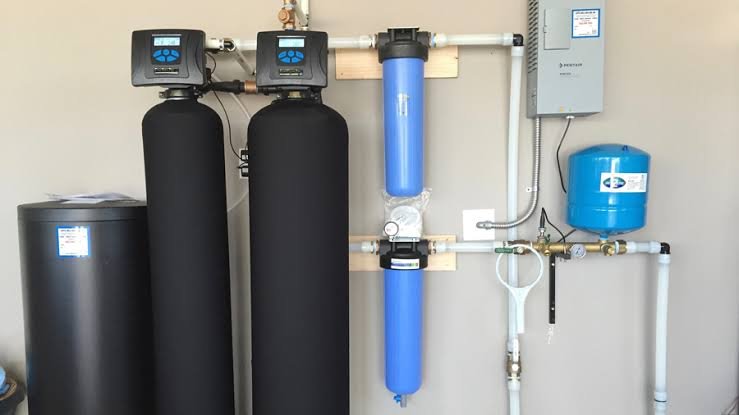
A whole-home softener is installed on the main water line so that treated water reaches multiple fixtures throughout the property.
For households experiencing widespread scale, this can be a convenient approach. You aren’t constantly cleaning individual fixtures or changing multiple small filters.
But again, system sizing matters. A treatment system should be selected according to household size, water usage, flow rate, and actual hardness levels.
What About Salt-Free Conditioners?
Salt-free water conditioners are sometimes marketed as alternatives to traditional softeners. They may help reduce the tendency of minerals to form scale, but they generally don’t remove calcium and magnesium from the water in the same way a conventional ion-exchange softener does.
That distinction is important.
If your goal is specifically to reduce hardness minerals, a traditional softener may be more appropriate. If your priority is scale control and you don’t want a salt-based system, a conditioner could be worth investigating.
The best choice depends on what you’re trying to accomplish.
Maintenance Shouldn’t Be an Afterthought
A water softener isn’t completely maintenance-free.
Salt-based systems need regular salt replenishment, and the brine tank should be checked periodically. Some systems may also require cleaning or professional servicing.
Keep an eye on performance. If scale suddenly returns, water quality changes, or the system seems to regenerate unusually often, something may need attention.
Sometimes the fix is simple, such as adding salt or correcting a setting. Other times, a component may need inspection.
Regular maintenance is usually easier and cheaper than waiting until the system stops working altogether.
Look at the Long-Term Cost
When shopping for a water softener, don’t focus only on the initial price.
Consider installation, salt consumption, electricity use, replacement parts, service requirements, and warranty coverage. A system that costs less upfront may not necessarily be the most economical over several years.
Ask how much salt the system is expected to use and how often it regenerates. Efficient systems can reduce operating costs, particularly in households with significant water consumption.
It’s also worth asking whether professional servicing is available locally and whether replacement parts are easy to obtain.
When Professional Advice Helps
If you’re unsure whether hard water is actually the main issue, professional guidance can save you from buying the wrong equipment.
A qualified water treatment provider can test the water, explain the results, estimate household demand, and recommend equipment based on those factors.
Don’t hesitate to ask questions. What exactly will the system treat? What won’t it treat? How often does it need maintenance? What are the ongoing costs?
A good recommendation should make sense even after the sales pitch is over.
Better Water Starts With Better Information
Hard water is rarely an overnight problem. It builds quietly, leaving scale and mineral deposits until they become impossible to ignore.
The good news is that homeowners have practical options. Start by testing your water and understanding the actual hardness level. Then compare treatment technologies based on what you want to improve, how much water your household uses, and what you’re comfortable maintaining.
You don’t necessarily need the biggest or most expensive system. You need one that fits your home.
Once the right treatment is in place, the benefits can be wonderfully ordinary: cleaner fixtures, fewer spots on dishes, easier cleaning, and appliances that aren’t constantly fighting mineral buildup.
Sometimes improving a home isn’t about making a dramatic change. It’s about fixing the little things that quietly make everyday life harder.